SaaS · Resume Builder · AI Integration
GoDiverse Resume Builder
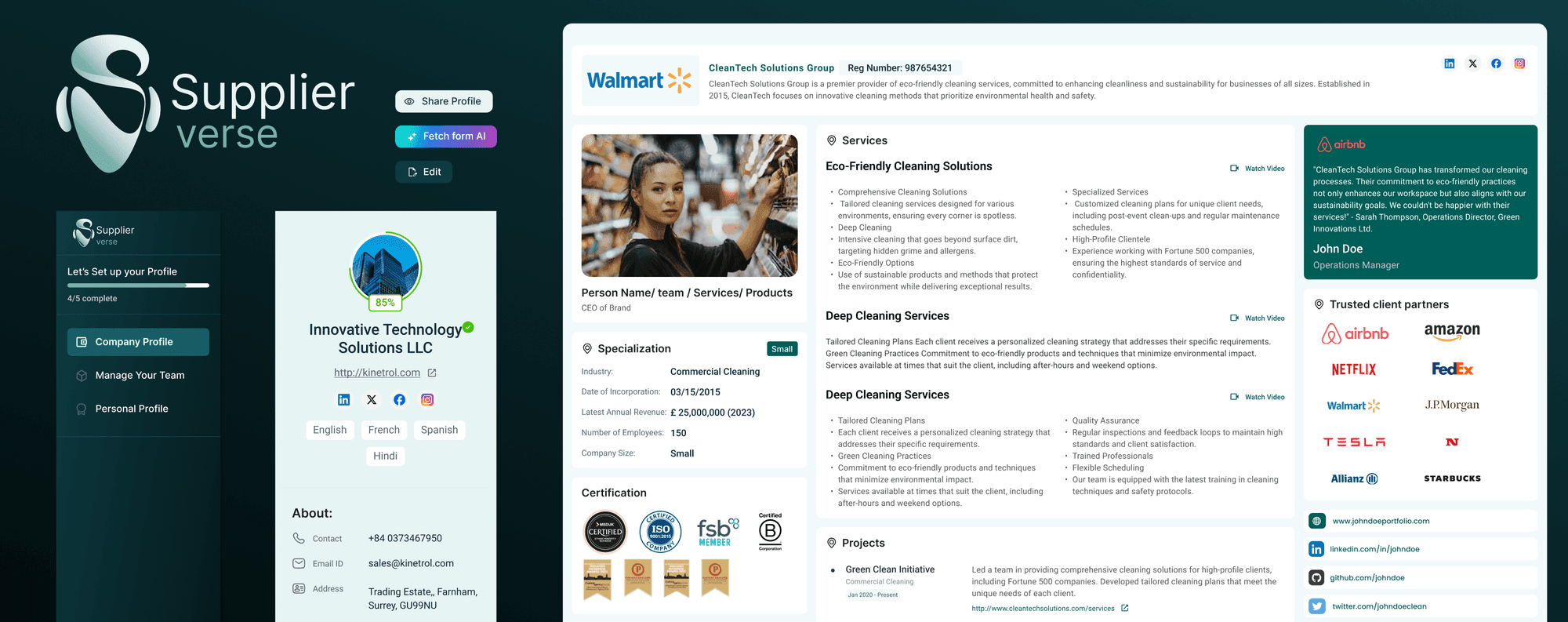
A 1-page profile builder for suppliers on a supplier-diversity platform — create, share by link, download as PDF, or print. All in one flow. AI-assisted content generation built in.
< 8 min
Design target: signup to first shared profile.
3-in-1
Distribution — link, PDF, and print from a single build.
3
Optional AI touchpoints — summary, bullets, skills — each editable by the user.
The short version
- The problem
- Suppliers on a diversity platform had no fast way to present themselves — and a profile nobody can share, print or send as a PDF is a profile that never leaves the platform.
- The call
- Treat one page as the design strategy, not a limitation — it forces every decision toward clarity and speed, and makes three distribution channels out of a single build.
- What I owned
- Hired as a designer and ended up scoping the product: industry research, the AI integration points, and every screen. Two months, blank brief to buildable spec.
- The outcome
- A share-first pitching tool — link, PDF and print from one build, with three optional AI touchpoints the user can always edit.
- Company
- GoDiverse
- My role
- UI/UX Consultant → Design Lead
- Platform
- Web, SaaS
- Duration
- 2 Months (Oct–Nov 2025)
2 engineers, 1 designer (me), 1 content strategist — agile sprints
Tools · Figma · Jira · React · Tailwind CSS · Puppeteer · Claude API
Context
Hired as a designer. Ended up scoping the product.
GoDiverse had the brand and the audience — a UK supplier-diversity SaaS platform connecting underrepresented suppliers with global corporations. What they didn't have was a clear product scope for the profile builder suppliers would use to pitch themselves. I was brought in as a UI/UX consultant, but quickly took ownership of defining what to build, how AI should integrate, and the full user flow from creation to distribution.
Scoped the Product
Defined the feature set, user flows, and technical constraints. Turned a vague brief into a buildable spec with clear acceptance criteria.
Industry Research
Audited 12+ resume builders (Canva, Zety, Novoresume, Resume.io). Mapped feature gaps, pricing models, and distribution patterns.
AI Integration Strategy
Defined how AI should assist content creation — not replace the user, but accelerate first drafts of summaries, skills, and experience descriptions.
The Problem
Resume builders are either too complex or too generic.
I audited 12+ resume builders (Canva, Zety, Novoresume, Resume.io). They fell into two camps: enterprise-grade builders with 50+ templates and overwhelming UX, or minimal tools that produced cookie-cutter output.
Neither solved the core job-to-be-done: create a professional, distinctive 1-page profile in under 10 minutes, then share it instantly — by link, PDF, or print.
Complex Builders
Multi-page templates, 20+ section types, drag-and-drop complexity. Average time-to-first-resume: 30+ minutes. High drop-off before PDF export.
Generic Builders
Fast but forgettable. Cookie-cutter templates, no brand personality, no share-by-link. Output looks identical across every user.
The Strategic Bet
One page. One flow. Three distribution channels.
Instead of competing on template volume, I scoped the product around a single constraint: everything fits on one page. One page forces clarity, forces prioritization, and makes the output instantly shareable.
The distribution model was the real differentiator — every resume gets a unique shareable link, a server-side PDF export, and print-optimized formatting. Create once, distribute everywhere.
Share by Link
Every resume gets a unique URL. Share on LinkedIn, in emails, or embed anywhere. Edit once, the link reflects changes instantly.
Download as PDF
Server-side PDF generation via Puppeteer. WYSIWYG — no layout shifts, no broken fonts. ATS-compatible output.
Print-Ready
Print-optimized CSS renders perfectly on A4. Margins, typography, and spacing tuned for physical output.
Key Product Decisions
Every feature scoped against one question: does this help someone go from blank page to shared resume faster?
Structured Sections, Not Free-Form
Fixed section types (Summary, Experience, Education, Skills) with flexible content inside. Prevents layout breakage while giving creative control.
Live Preview
Real-time preview as users type. No save-and-preview loop. What you see is exactly what the PDF and link show.
Brand-First Templates
Not 200 options — 5 curated templates, each optimized for readability, ATS parsing, and visual distinction.
One-Page Constraint
The system enforces a single page. Content overflow triggers smart truncation hints instead of spilling to page two.
AI Integration
AI as an accelerator, not a replacement. Three optional touchpoints — each editable, each designed to get users from blank field to strong first draft in one click.
Professional Summary
User inputs role + experience. AI generates a tailored 3-line summary. Editable, regenerable, always the user's call.
Experience Bullets
Plain language in, achievement-oriented bullets out. “Managed a team” becomes “Led a cross-functional team of 8.”
Skills Suggestions
AI suggests relevant hard and soft skills based on role. Users pick or add their own. No guesswork.
What didn't work first
First version auto-generated the entire resume from a job title. Users didn't trust it — the output didn't feel “theirs.” Iterated: section-level AI assists users trigger manually. Trust went up, completion followed.
What I Said No To
The Product
UX built around reducing time-to-value. No onboarding tour. Users land on the builder, see their profile taking shape in real time, and hit share.
Outcomes
Scoped and designed in a 2-month engagement. The constraint-driven approach — one page, three distribution channels, AI-assisted content — produced a focused product that solved a real job-to-be-done.
< 8 min
Design target: signup to first shared profile.
3-in-1
Distribution — link, PDF, and print from a single build.
3
Optional AI touchpoints — summary, bullets, skills — each editable by the user.
The Real Story
Constraints are product decisions. Not compromises.
The one-page constraint wasn't a limitation — it was the design strategy. It forced every design decision toward clarity and speed. Combined with AI-assisted content and three distribution channels, it turned a profile builder into a share-first pitching tool for suppliers.
I scoped the product, ran the industry research, defined the AI integration points, and designed every screen — a 2-month consulting engagement from blank brief to buildable spec.